
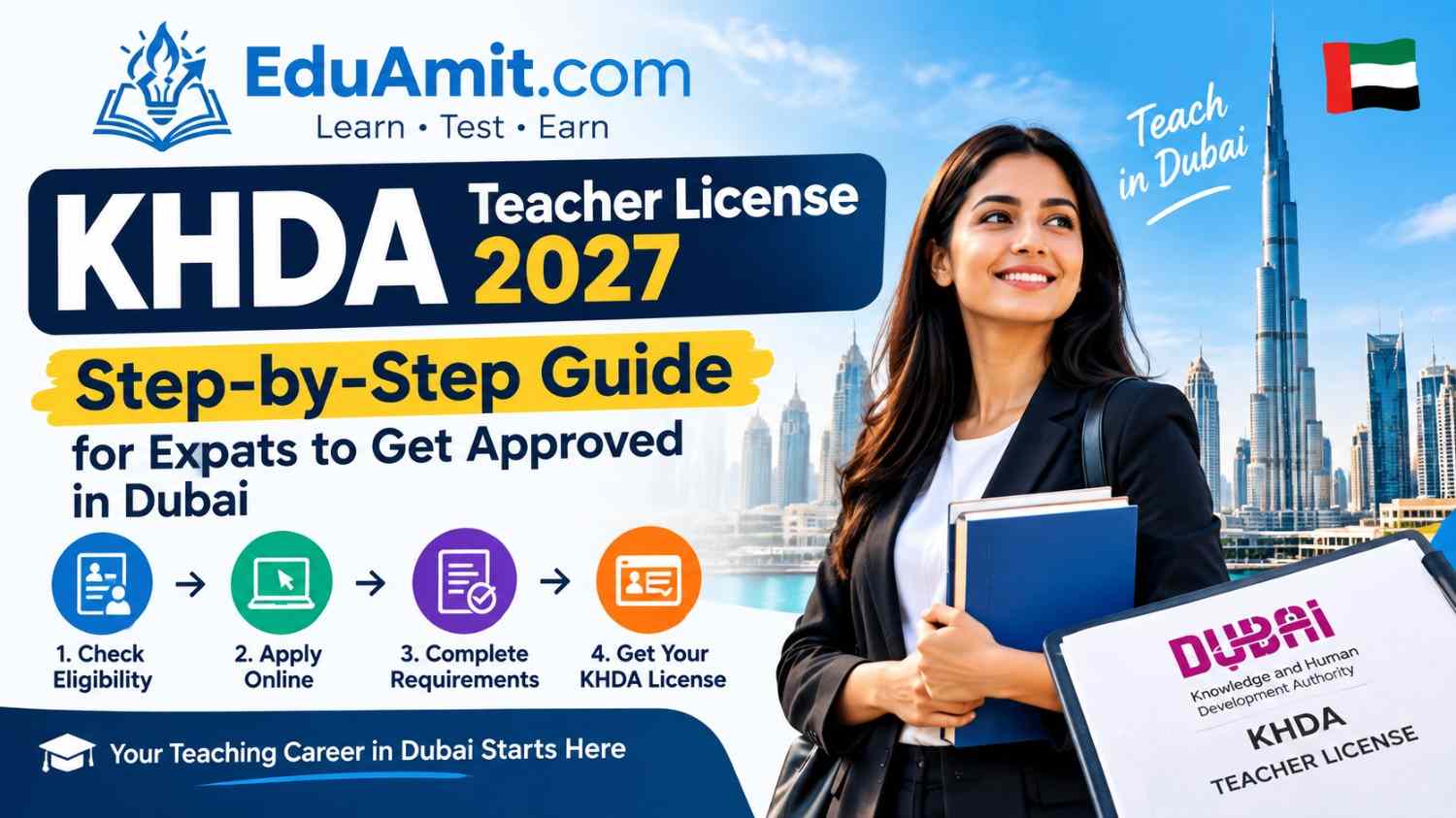
Dubai’s private education sector is one of the most dynamic and rapidly expanding school ecosystems in the world. However, if you are an expat planning to teach in Dubai in 2027, you cannot simply walk into a classroom with a standard degree and start teaching. You must obtain official approval and licensing from the Knowledge and Human Development Authority (KHDA).
The KHDA is the regulatory body overseeing private schools, early learning centers, and universities in Dubai. In 2027, the licensing framework—often integrated with the national UAE Teacher Licensing System (TLS)—requires strict adherence to updated professional standards.
This comprehensive guide walks you through every step of securing your KHDA teacher licence in 2027, covering exact requirements, timelines, costs, training programs, and salary expectations for expat teachers.
What Does a KHDA Certificate and License Mean?
To navigate the system successfully, you must first understand the terminology. Many expat teachers confuse a KHDA Certificate, KHDA Approval, and the UAE Teacher License (TLS).
be hired by a school)
licence to practice)
KHDA Initial Approval: This is the administrative green light given to a school to hire you. It confirms that your academic credentials match the subject and grade level you are assigned to teach.
KHDA Teacher Licence (under the TLS): This is the formal, legal teaching license in the UAE. It requires passing standardized pedagogical and subject-matter examinations, as well as submitting attested qualifications.
KHDA Certificate: This refers to the professional development and training credentials issued by KHDA-approved institutes in Dubai to bridge qualification gaps.
In 2027, the process is highly digitized. The KHDA operates in sync with the federal Ministry of Education (MoE) to ensure that every teacher in Dubai meets global quality benchmarks.
What Qualifications Do You Need to Be a Teacher in Dubai?
The entry requirements for expat teachers in 2027 are rigorous. The KHDA evaluates your application based on three core pillars: academic qualification, subject specialization, and pedagogical competence.
Academic Qualifications
For Class Teachers (Primary/Elementary): You must hold a recognized Bachelor of Education (B.Ed.) or an equivalent degree in
primary education.
For Subject Teachers (Secondary/Middle School): You must hold a specialized Bachelor’s degree in the subject you intend to teach (e.g., a Bachelor of Science in Physics to teach high school Physics), alongside an approved teaching diploma or PGCE (Postgraduate Certificate in Education).
Attestation: Your degrees must be fully attested by the Ministry of Foreign Affairs (MoFA) in your home country, the UAE Embassy in your home country, and the Ministry of Foreign Affairs within the UAE.
Can You Teach in the UAE Without a Teaching Degree?
Yes, but with strict conditions. If you have a highly specialized Bachelor’s degree (for example, in Engineering or Biochemistry) but do not have a B.Ed. or PGCE, you can still teach in Dubai. However, you will be required to complete a KHDA-approved teacher preparation program or a recognized postgraduate diploma in education within a specified timeline after your initial employment.
Language Proficiency
As an expat, you must prove your language proficiency based on the language of instruction at your school:
For English-medium curricula (British, American, IB, CBSE), non-native English speakers must score at least 7.0 in IELTS Academic (or equivalent).
For Arabic teachers, specific proficiency exams approved by the MoE are mandatory.
How to Get a Teacher License in the UAE: 2027 Step-by-Step
The licensing process in 2027 is primarily managed online through the school that hires you, but it requires active preparation from your side.
▼
▼
▼
▼
▼
Step 1: Secure a Legal Job Offer
Unlike some countries where you can apply for a teaching license independently before moving, Dubai requires you to have an employer. Your hiring school acts as your government liaison. The school’s HR department will initiate your profile on the KHDA system.
Step 2: Complete the Verification and Attestation Process
Before your school can register you, you must verify your academic credentials.
- Primary Verification (DataFlow): Many schools and regulators use the DataFlow Group to conduct background checks and verify the authenticity of your degree directly from your issuing university.
- MoFA Attestation: Upload your degree to the UAE Ministry of Foreign Affairs e-register to receive the digital attestation sticker.
Step 3: School Submits Initial Approval to KHDA
The school uploads your attested certificates, passport, visa details, and signed contract to the KHDA portal. KHDA reviews your profile. If your degree matches your assigned teaching load, they issue an Initial Appointment. This allows you to legally step into the classroom while you work on your full license.
Step 4: Register on the Teacher Licensing System (TLS) Portal
Once your initial appointment is active, you must register on the federal TLS portal. The TLS is a standardized nationwide system that ensures all teachers in the UAE—including those in Dubai, Abu Dhabi, and the Northern Emirates—meet the same high standards.
Step 5: Prepare for and Pass the TLS Exams
To transition from “approved” to “fully licensed,” you must sit for two primary exams:
- Pedagogy Exam: Assesses your understanding of teaching methodologies, classroom management, student psychology, and inclusive education.
- Subject Specialization Exam: Tests your deep knowledge of the specific academic subject you are teaching.
If you fail an exam, the system allows you to re-sit after a specified period, but you must complete your approved training modules in the interim.
Step 6: Final License Issuance
Upon clearing the exams and submitting all clean background checks (including a UAE Police Clearance Certificate), the KHDA, in partnership with the MoE, issues your official UAE Teacher License, which is valid for up to 3 years and renewable.
How Long Does It Take to Get KHDA Approval in Dubai?
Change block type or style
Move Heading block from position 27 up to position 26
Move Heading block from position 27 down to position 28
Change alignment
Change text alignment
Displays more block tools
The timeline for securing your KHDA approval can vary based on your preparation:
| Phase | Estimated Duration | Key Factors influencing time |
|---|---|---|
| Document Attestation | 2 to 6 weeks | Your home country’s bureaucracy and embassy processing times. |
| DataFlow Verification | 3 to 5 weeks | The responsiveness of your alma mater’s registrar. |
| KHDA Initial Approval | 5 to 10 working days | Handled instantly online by the school once documents are complete. |
To avoid delays, start your home-country document attestation at least three months before your planned relocation date to Dubai.
Cost Breakdown: How Much Does It Cost?
While schools often cover the administrative fees associated with your residency visa, the costs associated with academic attestation and licensing exams are typically borne by the teacher.
Degree Attestation (Home Country + UAE MoFA): $150 – $400 (AED 550 – AED 1,470) depending on your home country.
DataFlow Verification Fee: AED 500 – AED 900.
TLS Exam Fees (per attempt): Approximately AED 250 – AED 500 per exam.
Police Clearance Certificate: AED 50 – AED 220.
Tip: Always negotiate with your prospective school during the offer stage to see if they offer a relocation allowance that covers these preliminary licensing costs.
KHDA-Approved Teacher Training Courses and Institutes
If you are an expat teaching without an education degree, or if you need to upgrade your credentials to meet the 2027 standards, you must enroll in a recognized program.
Approved Training Institutes in Dubai
- The British University in Dubai (BUiD): Famous for offering high-level PGCE and Master of Education programs tailored specifically to the UAE curriculum standards.
- Middlesex University Dubai: Offers widely respected Postgraduate Certificates in Education (PGCE) recognized internationally and by the KHDA.
- Eton Institute: Offers specialized short courses, TEFL, and language support classes approved for professional development hours.
- Zabeel International Institute: Provides various executive education and teacher development workshops approved by local authorities.
What are some KHDA-approved courses?
PGCE (Postgraduate Certificate in Education): The gold standard for subject specialists who want to teach in British or International IB schools.
ECHO / Teacher Preparation Programs: Shorter modular courses focusing on classroom dynamics, differentiated learning, and UAE moral education guidelines.
Special Education Needs (SEN) Certifications: Highly demanded courses that train teachers to support students of determination (special needs).
What Teachers are in Demand in Dubai for 2027?
Dubai’s education landscape is evolving with a massive push toward future-focused skills. The most sought-after expat teaching roles in 2027 include:
STEAM Educators: Teachers who can seamlessly blend Science, Technology, Engineering, Art, and Mathematics.
Inclusion Specialists (SEN Teachers): Dubai has a major policy drive to make all private schools fully inclusive. Experts in learning difficulties, autism, and behavioral therapy are in extremely high demand.
Primary School Homeroom Teachers: Due to population growth and a continuous influx of expat families, primary school classes are expanding rapidly.
Secondary Subject Specialists: Particularly in AP/IB Chemistry, Physics, Advanced Mathematics, and Computer Science.
Dubai Teacher Salaries: What to Expect in 2027
A major draw for expats moving to Dubai is the tax-free salary and the comprehensive benefits package.
What is the average salary for a teacher in Dubai?
Salaries vary widely depending on your experience, your qualifications, and the curriculum of the school:
Tier 1 International Schools
(IB / British Curricula): AED 15,000 to AED 22,000 per month tax-free. These positions usually include free furnished accommodation (or a high housing allowance), annual return flights, comprehensive medical insurance, and tuition fee waivers for 1-2 dependent children.
Tier 2 Schools
(American / Indian / CBSE Curricula): AED 9,000 to AED 14,000 per month. Accommodation is often provided, but the overall benefits package may be more modest.
Early Years and Nursery Teachers: AED 7,000 to AED 11,000 per month.
Salary FAQ Breakdown
Is AED 50,000 a month a good salary in Dubai? Yes, AED 50,000 a month is an exceptional, high-executive level salary in Dubai. It is extremely rare for a classroom teacher to earn this amount. This level of compensation is typically reserved for School Principals, Superintendents, or regional Academic Directors of major education groups (like GEMS or Taaleem).
Can I live in Dubai with a $4,000 (AED 14,700) monthly salary? Absolutely. If your school provides free accommodation, a salary of $4,000 per month allows you to live very comfortably, dine out, save money, and travel during school holidays. If you must pay your own rent out of that amount, it is still very doable, but you will need to budget carefully regarding your choice of neighborhood and transport.
Abu Dhabi vs. Dubai: Which is Better for Teachers?
Expats often compare Dubai with Abu Dhabi when considering teaching in the UAE.
• Highly diverse, fast-paced
• Cosmopolitan social life
• Higher cost of living
• Slightly higher average base salaries
• More relaxed, family-oriented lifestyle
• Lower rent and utility costs
While Abu Dhabi is the wealthier emirate capital-wise and often funds massive public school initiatives (through organizations like Charter Schools), Dubai offers a vastly diverse and competitive private school market.
Many teachers find that while Abu Dhabi offers slightly higher initial savings potential, Dubai provides a more dynamic, internationally connected lifestyle and a wider array of professional growth opportunities within premium school networks.
Frequently Asked Questions (FAQs)
Is there an online school in Dubai that is KHDA approved?
Yes. Dubai has fully embraced digital education. Online schools like iCademy Middle East are fully registered and approved by the KHDA. Expats can teach for these online platforms, but they must still possess a valid residency visa and undergo the same KHDA background checks and qualifications verification.
Can I teach in Dubai on a spouse’s visa?
Yes. If you are sponsored by your spouse’s residency visa, you do not need the school to sponsor your residency. However, your school must still apply for a Work Permit from the Ministry of Human Resources and Emiratisation (MoHRE) and secure your KHDA Initial Appointment and subsequent teacher license.
What happens if I fail the TLS Exam?
If you do not pass your licensing exams on the first try, do not panic. The system allows you to take remedial training courses and re-register for the exams. Your school can retain you on your “Initial Appointment” status for a designated period while you work toward passing the exams.
- Final Checklist for Expat Teachers in 2027
To make your transition to Dubai’s education sector as smooth as possible, follow this step-by-step checklist:
- Check your degree: Verify that your major matches the exact subject you want to teach.
- Begin Attestation Early: Secure university transcripts, degree certificates, and police clearances. Get them stamped by your local government and the UAE Embassy.
- Prepare your English Proficiency: If applicable, sit for the IELTS Academic exam and aim for a band score of 7.0 or higher.
- Update your Digital CV: Highlight your experience with international curricula (IB, British National Curriculum, American Common Core).
- Apply to KHDA-Approved Private Schools: Use official portals like Schrole, Search Associates, or school group portals (GEMS Education, Taaleem, Cognita).
- Initiate TLS Registration: Once hired, coordinate with your school’s PRO to initiate your DataFlow verification and register on the UAE TLS portal.
By understanding the rules, aligning your qualifications early, and leveraging the support of your hiring school, you can successfully secure your KHDA teacher licence and thrive in one of the world’s most rewarding international teaching environments.
- Mitosis and Meiosis Quiz: Practice Questions, Answers, Phases & Key Differences
- National Spanish Exam Level 2 Practice Quiz Free: A Complete Guide to Raise Your Score
- Random Group Generator Free – Create Random Teams & Groups Instantly
- CompTIA A+ 1201 Practice Test Free: Questions, Answers & Exam Prep Guide
- Free Printable 3rd Grade Worksheets