
AP Chemistry Score Calculator 2026
Predict your AP Chemistry score (1–5) in seconds
Enter Your Scores
This is an unofficial estimate based on historical AP Chemistry scoring data. The official 2026 curve may differ.
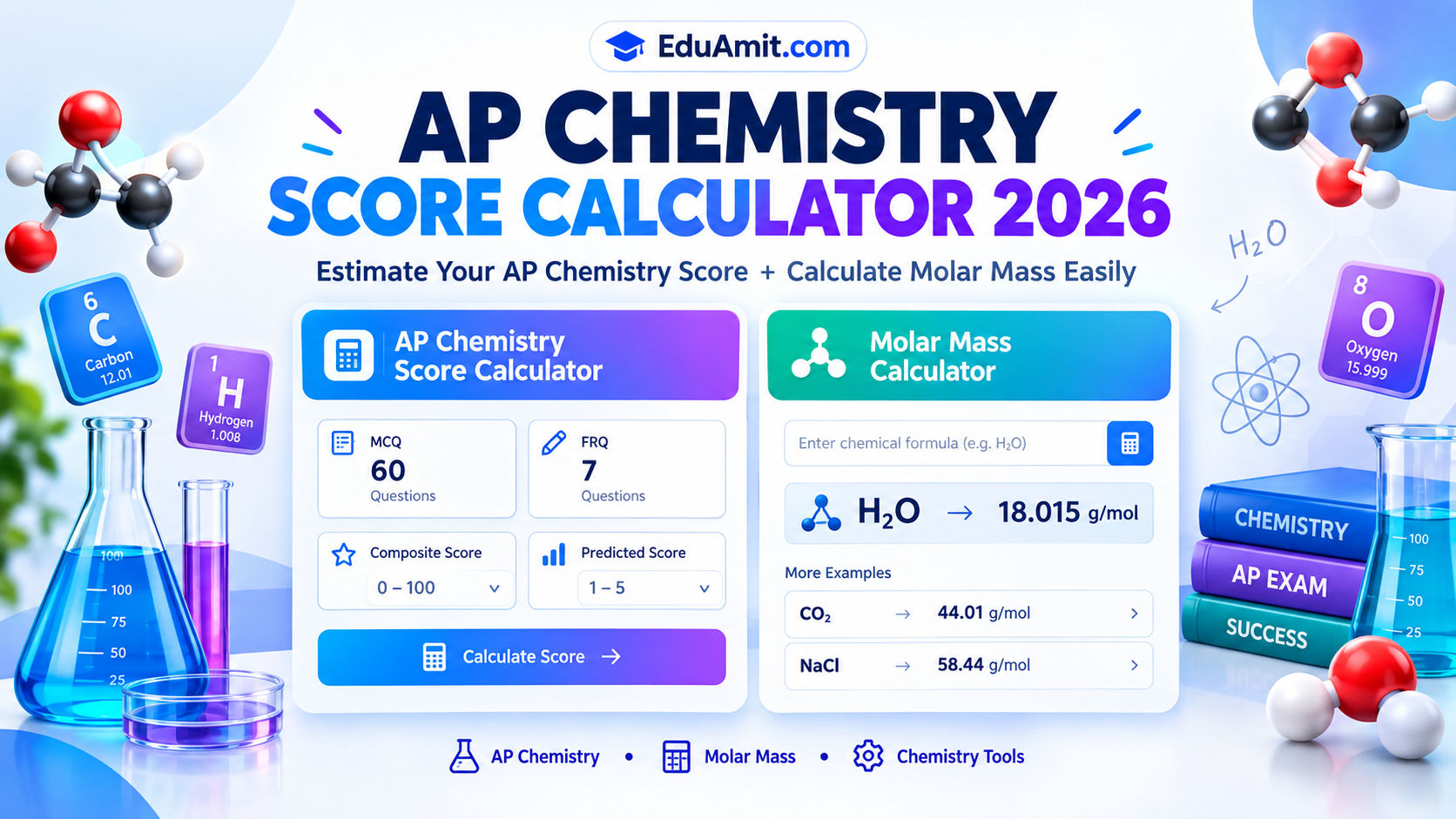
If you are a student preparing for the AP Chemistry exam, you have probably heard the words “molar mass” and “raw score” more times than you can count. The exam is tough, but the right tools can make your study time much more productive. Two tools stand out above the rest: the AP Chemistry Score Calculator 2026 and the Molar Mass (MA) Calculator. When you understand how to use them together, you can predict your final score, fix weak spots, and walk into test day with real confidence.
This guide is written in simple language, is 100% original, and is built to rank well on search engines. Let’s get started.
What Is the AP Chemistry Score Calculator 2026?
The AP Chemistry Score Calculator 2026 is an online tool that predicts your final AP score (from 1 to 5) based on your performance on a practice exam. Instead of guessing how many multiple-choice questions you need to get right, the calculator does the math for you. It uses the most recent scoring curves from the College Board, which is important because the curve often changes from year to year.
Why Should You Use It?
- It saves time – You get an instant score estimate without doing any conversion math yourself.
- It is accurate – A good calculator uses the same weighting the College Board uses.
- It helps you set goals – If your estimated score is a 3, you know you need to work harder on FRQs.
- It reduces test anxiety – Knowing roughly where you stand makes the real exam feel less scary.
How to Use the Calculator – Step-by-Step Guide
Using the AP Chemistry Score Calculator 2026 is very simple. Follow these steps:
- Step 1: Take a full-length practice exam under real test conditions (timed, quiet room, no phone).
- Step 2: Count how many multiple-choice questions you answered correctly out of 60.
- Step 3: Score your free-response questions. The AP Chemistry exam has 7 FRQs. Each question is usually worth 4 to 10 points depending on the question type. Total your FRQ points.
- Step 4: Open the AP Chemistry Score Calculator 2026 and enter your MCQ score and your total FRQ score.
- Step 5: Click “Calculate.” You will instantly see your estimated AP score from 1 to 5.
Tip: Always use a calculator that is updated for the 2026 exam year. Older calculators may use outdated curves and give you the wrong estimate.
Understanding the AP Chemistry Scoring Format
Before you trust any score calculator, it helps to understand how the real AP Chemistry exam is scored. The exam has two main parts, and they count equally.
- Section I: Multiple Choice (MCQ) – 60 questions, 90 minutes, worth 50% of your final score. There is no penalty for guessing.
- Section II: Free Response (FRQ) – 7 questions, 105 minutes, worth 50% of your final score. These test your ability to explain concepts, solve multi-step problems, and design experiments.
Your MCQ raw score and FRQ raw score are combined into a single composite score. The composite score is then mapped to the 1–5 AP scale. While the exact cutoffs change slightly each year, a typical AP Chemistry conversion looks like this:
| Composite Score Range | AP Score |
|---|---|
| 126 to 180 | 5 |
| 97 to 125 | 4 |
| 76 to 96 | 3 |
| 58 to 75 | 2 |
| 0 to 57 | 1 |
. A score of 4 or 5 is considered excellent and can earn you college credit at many universities.
What Is a Molar Mass (MA) Calculator?
A Molar Mass Calculator (also called an MA calculator) is a tool that tells you the molar mass of any chemical compound. . This number is critical for almost every calculation in AP Chemistry, from stoichiometry to solution chemistry.
For example:
- Sodium chloride (NaCl) has a molar mass of about 58.44 g/mol.
- Glucose (C₆H₁₂O₆) has a molar mass of about 180.16 g/mol.
How to Use the MA Calculator
The molar mass calculator is even easier to use than the score calculator:
- Step 1: Type the chemical formula into the input box. For example, type Ca(OH)₂ or Fe₂(SO₄)₃.
- Step 2: Click “Calculate.”
- Step 3: Read the result. Most calculators also show a breakdown of each element’s contribution, which is great for learning.
Why Is the Molar Mass Calculator So Important?
- Speed: Doing molar mass calculations by hand takes time. The calculator gives you the answer in less than a second.
- Accuracy: A small mistake in counting atoms can throw off an entire problem. The calculator prevents this.
- Learning aid: By looking at the breakdown, you can see exactly how the final number is built.
Remember: On the actual AP Chemistry exam, you will not have access to a digital molar mass calculator. You will need to know how to calculate molar mass using the periodic table. Use the MA calculator as a study tool to check your work and reinforce the method.
How These Two Calculators Work Together
The real magic happens when you combine both tools in your study routine. Here is a simple 4-step weekly plan:
- Take a practice exam. Use official College Board past exams if possible.
- Score it and enter your results into the AP Chemistry Score Calculator 2026. Write down your estimated AP score.
- Look at the questions you missed. Many students lose points on stoichiometry, gas laws, and acid-base problems. Almost all of these require molar mass calculations.
- Re-do the missed problems using the Molar Mass Calculator. Check your manual work against the calculator. Repeat until you can do the calculation perfectly without help.
After a few weeks of this cycle, you will see your estimated AP score climb. This is one of the most effective ways to study for AP Chemistry.
SEO Tips for Creating a Calculator Article That Ranks
If you are a blogger or educator writing about these calculators, follow these SEO best practices so your article can rank on the first page of Google.
- Use the main keyword in the title: “AP Chemistry Score Calculator 2026” should appear in your H1.
- Use related keywords naturally: Include phrases like “AP score predictor,” “molar mass calculator,” “AP Chemistry practice exam,” and “how to calculate AP score.”
- Write a strong meta description: Keep it under 160 characters and include the primary keyword.
- Structure with headings: Use H2 for main sections and H3 for subsections. This helps both readers and search engines.
- Aim for 1500 to 2000 words: Long-form, original content tends to rank better. Make sure every paragraph adds new value.
- Add FAQs: Include a Frequently Asked Questions section at the end with questions like “How accurate is the AP Chemistry Score Calculator?” and “What is the formula for molar mass?” This captures featured snippets on Google.
- Use internal and external links: Link to official College Board resources and your own related articles.
- Optimize images: If you add screenshots, use descriptive file names and alt text with your keywords.
- Update yearly: Refresh the article every January with the new exam year and any changes to the scoring format.
Common Mistakes Students Make With These Tools
Avoid these common errors:
- Using outdated calculators: The College Board changes curves often. Always use a 2026 calculator for the 2026 exam.
- Trusting the estimate too much: A score calculator is a guide, not a guarantee. Your real score depends on the actual exam difficulty.
- Skipping the math: Relying on the molar mass calculator without learning the manual method will hurt you on test day.
- Not practicing FRQs: The score calculator is most accurate when your FRQ scoring is honest. Be strict when grading yourself.
Frequently Asked Questions (FAQ)
Q1: Is the AP Chemistry Score Calculator 2026 free?
Most online calculators are free. Just make sure you are using one that does not require personal information or payment.
Q2: How accurate is the predicted score?
A good calculator gives an estimate within about 1 point on the AP scale. Your real score can still vary depending on exam difficulty and grading.
Q3: Can I use a molar mass calculator on the AP Chemistry exam?
No. You are not allowed to bring any calculator to the AP Chemistry exam. All calculations must be done by hand or mentally. Use the MA calculator only while studying.
Q4: What is a passing score on AP Chemistry?
Most colleges accept a score of 3 or higher, but competitive schools prefer a 4 or 5.
Q5: How long should I study before taking the AP Chemistry exam?
Most students study for 2 to 3 months. Use the score calculator regularly to track your progress.
Final Thoughts
The AP Chemistry exam is challenging, but you do not have to face it unprepared. The AP Chemistry Score Calculator 2026 gives you a realistic estimate of where you stand, while the Molar Mass Calculator helps you master one of the most important skills in chemistry. When you use them together in a regular study routine, you build both speed and accuracy. Stay consistent, practice under real test conditions, and update your tools every year. Good luck on your 2026 AP Chemistry exam – a score of 5 is absolutely within reach.
- Mitosis and Meiosis Quiz: Practice Questions, Answers, Phases & Key DifferencesCell division is one of the most important processes that keeps living things alive. Every time your skin heals,… Read more: Mitosis and Meiosis Quiz: Practice Questions, Answers, Phases & Key Differences
- National Spanish Exam Level 2 Practice Quiz Free: A Complete Guide to Raise Your ScoreIf you’re looking for a solid National Spanish Exam Level 2 practice quiz free, you’re probably not just trying… Read more: National Spanish Exam Level 2 Practice Quiz Free: A Complete Guide to Raise Your Score
- Random Group Generator Free – Create Random Teams & Groups InstantlyCreating groups should be simple. But when you have 25 students waiting for assignments, 40 employees attending a workshop,… Read more: Random Group Generator Free – Create Random Teams & Groups Instantly
- CompTIA A+ 1201 Practice Test Free: Questions, Answers & Exam Prep GuideEither you just booked your Core 1 exam and your stomach dropped a little, or you’ve been studying for… Read more: CompTIA A+ 1201 Practice Test Free: Questions, Answers & Exam Prep Guide
- Free Printable 3rd Grade WorksheetsSometimes, you need one helpful worksheet. Not ten. Not twenty. And certainly not a whole page of links. These… Read more: Free Printable 3rd Grade Worksheets
- `SAT Grammar Rules Cheat Sheet (2026)Contents Introduction What Makes Digital SAT Grammar Different Top SAT Grammar Rules Must-Know Punctuation Rules Clarity, Style, and… Read more: `SAT Grammar Rules Cheat Sheet (2026)
- Photomath vs Mathway vs Symbolab for Algebra 2: Which One Is Actually Better in 2026–27?If you’re stuck on a logarithm problem at 10 p.m., you don’t want a review. You want to know… Read more: Photomath vs Mathway vs Symbolab for Algebra 2: Which One Is Actually Better in 2026–27?
- LSAT Score Calculator: Raw to Scaled Score Conversion GuideLSAT Score Calculator Raw Score to Scaled Score Estimator Correct Answers Estimated Scaled Score 160 Score range: 120–180 Raw… Read more: LSAT Score Calculator: Raw to Scaled Score Conversion Guide
- AP Physics C Mechanics Score CalculatorAP Physics C: Mechanics Score Calculator Enter your multiple-choice and free-response points to instantly estimate your… Read more: AP Physics C Mechanics Score Calculator
- How to Get a CES Report from CGFNS OnlineIntroduction If you’ve been told you need a CES report for U.S. nursing licensure, you’re not alone. For many… Read more: How to Get a CES Report from CGFNS Online
- How to Get a CES Report from CGFNS OnlineIntroduction If you’ve been told you need a CES report for U.S. nursing licensure, you’re not alone. For… Read more: How to Get a CES Report from CGFNS Online
- AP Chemistry Score Calculator 2026AP Chemistry Score Calculator 2026 – Predict Your Score Instantly AP Chemistry Score Calculator 2026 Predict your AP Chemistry… Read more: AP Chemistry Score Calculator 2026
- KHDA Teacher License 2027: Step-by-Step Guide for Expats to Get Approved in DubaiDubai’s private education sector is one of the most dynamic and rapidly expanding school ecosystems in the world. However,… Read more: KHDA Teacher License 2027: Step-by-Step Guide for Expats to Get Approved in Dubai
- NIMS Dubai Admission 2026-2027: Fees, Eligibility, Dates & ProcessIntroduction: Why NIMS Dubai Admission 2026-2027 Is on Every Budget-Conscious Parent’s List Every year, thousands of Indian expatriate families… Read more: NIMS Dubai Admission 2026-2027: Fees, Eligibility, Dates & Process
- IGCSE & A-Levels (Cambridge): Complete Guide for Students in Gulf, Africa & AsiaIntroduction: Why Cambridge Qualifications Dominate Three Continents Walk into an international school in Dubai, Lagos, Nairobi, Karachi, Kuala Lumpur… Read more: IGCSE & A-Levels (Cambridge): Complete Guide for Students in Gulf, Africa & Asia
- uLesson vs PrepClass vs Passnownow: Which Is BestFinding the right e-learning platform in Nigeria isn’t easy. Every app promises better grades, exam success, and affordable learning… Read more: uLesson vs PrepClass vs Passnownow: Which Is Best
- PW vs Next Toppers Net Worth 2026: Who Is Richer?When it comes to India’s online education space, two names that always come up for comparison are PhysicsWallah (PW)… Read more: PW vs Next Toppers Net Worth 2026: Who Is Richer?
- What Grade Do I Need on My Final Exam Calculator USA?What Grade Do I Need on My Final Exam Calculator USA? The Ultimate Student Survival Guide to Passing, GPA,… Read more: What Grade Do I Need on My Final Exam Calculator USA?
- Study in USA Without IELTS | Complete 2026 GuideYes, you can study in the USA without IELTS. Many American universities now accept alternative English proficiency tests, waive… Read more: Study in USA Without IELTS | Complete 2026 Guide
- USA Scholarships for UAE Students 2027–2028Why the USA Should Be on Your Radar as a UAE Student If you’re dreaming of studying abroad but… Read more: USA Scholarships for UAE Students 2027–2028
- McGraw Hill vs Pearson vs HMH vs Barron’s — Which Is Best in 2027?Choosing a study book is confusing. All 4 brands look good, but they are NOT the same. Here is… Read more: McGraw Hill vs Pearson vs HMH vs Barron’s — Which Is Best in 2027?
- Alakh Pandey vs Prashant Kirad: Who is Better for Class 10?If you’re preparing for Class 10 boards and confused about which teacher to follow online, you’re not alone. Two… Read more: Alakh Pandey vs Prashant Kirad: Who is Better for Class 10?
- Oswaal vs Educart vs Arihant: Best Book for CBSE Class 10 (2026-27 Honest Review)swaal vs Educart vs Arihant: The Ultimate 2027 Comparison Guide For students entering the 2026-27 academic session, the pressure… Read more: Oswaal vs Educart vs Arihant: Best Book for CBSE Class 10 (2026-27 Honest Review)
- VTU SGPA, CGPA & Percentage Calculator 2027 – 2025, 2022, 2021, 2018 & 2015 SchemeVTU SGPA & CGPA Calculator 2015-2026 | All Schemes & Percentage 🌙 Dark Mode VTU Grade Calculator 2015-2026 Instant… Read more: VTU SGPA, CGPA & Percentage Calculator 2027 – 2025, 2022, 2021, 2018 & 2015 Scheme
- School Leaving Certificate TC Application 2026: Format, Samples & Step-by-Step GuideSchool Leaving Certificate TC Application 2026: Format, Samples & Step-by-Step Guide Changing schools is stressful enough. The last thing… Read more: School Leaving Certificate TC Application 2026: Format, Samples & Step-by-Step Guide
- Math speed testMaths Calculation Speed Test – Practice Fast Maths Online Maths Calculation Speed Test Practice • Calculate • Improve Select… Read more: Math speed test
- Next Toppers vs Vedantu vs Unacademy vs Physics Wallah 2026Choosing an online coaching platform for CBSE Class 9 or Class 10 can be confusing. Next Toppers, Vedantu, Unacademy,… Read more: Next Toppers vs Vedantu vs Unacademy vs Physics Wallah 2026
- Motion in a Straight Line Class 11 Notes — Formulas, NCERT Solutions & Handwritten PDFIf you’ve just started Class 11 Physics, “Motion in a Straight Line” is probably the first real chapter where… Read more: Motion in a Straight Line Class 11 Notes — Formulas, NCERT Solutions & Handwritten PDF
- Units and Measurements Class 11 Notes: NCERT Physics Chapter 1 [2026-27 free download PDF]Introduction Let’s be honest—ask any Class 11 student which physics chapter feels the most “boring” but shows up everywhere,… Read more: Units and Measurements Class 11 Notes: NCERT Physics Chapter 1 [2026-27 free download PDF]
- CBSE Class 10 Science Complete Chapter Guide All Chapters · Notes · Formulas · Exam Tips · 2026–27 Board Ready⚡ Physics Light – Reflection & Refraction Human Eye & Colourful World Electricity Magnetic Effects of Current Sources… Read more: CBSE Class 10 Science Complete Chapter Guide All Chapters · Notes · Formulas · Exam Tips · 2026–27 Board Ready
- The 5-Minute Mental Workout: 20 Visual Logic Puzzles to Sharp Your Mind TodayIQ Test Questions with Answers | 30 Brain Test Questions for Students
- Class 10 Science – Chapter 1: Chemical Reactions and EquationsImagine you go to the kitchen in the morning. You see your mother cooking rice. After some time, hard… Read more: Class 10 Science – Chapter 1: Chemical Reactions and Equations