
If you’re stuck on a logarithm problem at 10 p.m., you don’t want a review. You want to know which app to open. So here’s the short version first, and the reasoning after.
The quick answer
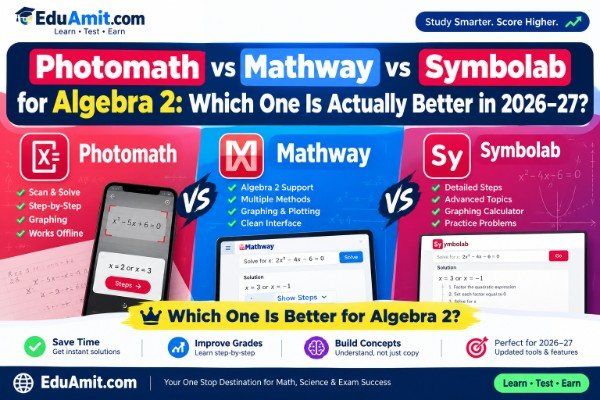
- Photomath is the best pick for most Algebra 2 students, especially on a phone. The camera scan is fast, and the steps are written to teach, not just to show off.
- Symbolab is the best pick when the problem gets ugly: long rational expressions, log equations, trig identities, series. It handles complicated input well and shows its work in detail.
- Mathway is the best pick when you only need an answer fast and you’re not fussed about the steps. It covers a huge range of topics, but the step-by-step part sits behind a paywall.
That’s the overall picture. The details matter, though, because Algebra 2 is where “just get the answer” stops working. Let’s go through it properly.
What makes Algebra 2 different from earlier math
Algebra 1 is mostly about solving for x. Algebra 2 is about understanding families of functions: quadratics, polynomials, exponentials, logarithms, rational functions, radicals. You also pick up complex numbers, systems with three variables, matrices, conic sections, sequences and series, and usually a first look at trig.
That changes what you need from a math app. A calculator that spits out “x = 3” isn’t enough, because your teacher will ask for the factoring, the domain restriction, the extraneous solution you had to throw out. A good app for this course has to do four things well:
- Read your problem correctly, whether you type it or photograph it.
- Show steps you can follow and copy into your own notes.
- Handle the specific Algebra 2 topics, not just generic equations.
- Cost something you can live with.
That’s the lens used below.
Photomath: the one built around your phone camera
Photomath started as a camera app, and it still feels like one. You point your phone at a printed problem, it reads it, and you get a solution almost instantly. Handwriting works too, though messy handwriting is where you’ll see the occasional misread. When that happens you can edit the expression before it solves, which saves you from retyping the whole thing.
What it does well for Algebra 2
- Quadratics, factoring and the quadratic formula are laid out cleanly, one move per line.
- It explains the why behind many steps, not just the what. For a student who’s confused about why you flip the inequality sign, that matters.
- Graphing is built in, so you can check a parabola or an exponential curve against your answer.
- The interface is calm. No clutter, no wall of ads fighting for your attention while you work.
Where it’s weaker
- Very complicated expressions, especially long nested fractions or heavy trig identities, can trip the scanner or produce less detailed steps than Symbolab.
- Some of the richer explanations and extras sit in the paid tier. The free version shows basic steps, which is enough for a lot of homework but not everything.
- It’s phone-first. You can use it elsewhere, but it’s not the tool you’d choose to sit at a laptop with.
Best for: students who learn by watching the steps happen, who do homework from a textbook or worksheet, and who want something quick and low-friction.
Mathway: the wide, fast, answer-first option
Mathway has been around a long time, and its strength is breadth. You pick a subject area, type or scan the problem, and it returns a result. It covers everything from basic math up through calculus and statistics, so you won’t outgrow it between Algebra 2 and Precalculus.
What it does well for Algebra 2
- It recognizes a lot of problem types. If your worksheet has “simplify,” “solve,” “find the domain,” “graph,” and “factor” in the same set, Mathway has a mode for each.
- It’s quick. For checking an answer you already worked out by hand, it’s hard to beat.
- The same app will carry you into higher math, so you’re learning one tool for several years.
Where it’s weaker
- The answer is usually free. The step-by-step explanation is the part you typically pay for. For a student trying to learn Algebra 2, that’s the most valuable piece, so it’s a real limitation.
- Because it’s so answer-focused, it’s easy to fall into copying results without understanding them. That feels fine until test day.
- The explanations, when you do get them, tend to be more mechanical than conversational.
Best for: students who mostly need to verify their own work, or who want one subscription that covers many math courses.
Symbolab: the one that handles the hard stuff
Symbolab leans toward the more mathematical side. It started on the web, and it shows. The input editor lets you build expressions precisely, which matters when you’re typing something like a rational equation with several terms in the numerator and denominator.
What it does well for Algebra 2
- Complicated expressions are its home turf. Logarithm equations, rational inequalities, polynomial division, partial fractions, and trig identities tend to come back with detailed, organized steps.
- It shows multiple solution paths for some problems, which is genuinely useful when your teacher’s method differs from the textbook’s.
- It has practice and study tools beyond the solver, so it can double as a revision aid before exams.
- Great for confirming the tricky parts: domain restrictions, extraneous solutions, sign analysis.
Where it’s weaker
- It can feel heavier. There’s more going on in the interface, and for a quick “is this right?” check, it’s more than you need.
- Full step-by-step access is limited on the free plan, so you’ll hit the paywall if you rely on it daily.
- Camera scanning exists, but if you live on your phone and only photograph problems, Photomath’s experience is smoother.
Best for: students who are already comfortable and want depth, anyone who works on a laptop, and anyone doing honors or advanced Algebra 2.
Side-by-side comparison
| Photomath | Mathway | Symbolab | |
| Main strength | Camera scan + teaching-style steps | Wide topic coverage, fast answers | Detailed steps on complex problems |
| Best on | Phone | Phone or web | Web, also phone |
| Steps on free plan | Basic | Limited, answer-first | Limited |
| Handles messy expressions | Good | Good | Excellent |
| Feels like | A patient tutor | A quick calculator | A serious study tool |
| Ideal Algebra 2 student | Most students | Answer checkers | Advanced or honors |
Plans and prices change often, so check each app’s current pricing in the app store or on its website before you subscribe. Most offer a free tier or trial, which is worth using before you commit.
Topic by topic: which app wins where
Quadratics and factoring. Photomath. The steps are clean and easy to copy, and graphing helps you see the roots.
Polynomials and long division. Symbolab. Long expressions with many terms are where its input and step detail pay off.
Rational expressions and equations. Symbolab again. Finding common denominators, flagging excluded values and catching extraneous solutions is where beginners slip, and the detail helps.
Radicals and exponents. A tie between Photomath and Mathway. Both handle these quickly. Photomath explains more; Mathway is faster if you only want the result.
Exponential and logarithmic equations. Symbolab, with Photomath as a solid second. Log properties are the area where seeing multiple steps clearly matters most.
Complex numbers. Mathway and Symbolab are both reliable. Photomath works too, but check that the answer is in the form your teacher wants (a + bi).
Systems of equations and matrices. Mathway has a mode for almost every variation. Symbolab is strong for larger systems.
Conic sections. Symbolab and Photomath, mainly for the graphing and the completing-the-square work.
Sequences and series. Symbolab. It’s built for this kind of structured problem.
Function transformations and graphing. Photomath. Seeing the graph next to the equation makes shifts and stretches click.
Free vs paid: what you actually get
Here’s the honest truth about all three. Free versions are good enough to check answers. Paid versions are what you need if you want the full reasoning, every time.
If you’re on a tight budget, a sensible approach is to use the free tier of one app for checking, and lean on your textbook, your teacher, and free video lessons for explanations. If you’re going to pay for just one, pick based on how you study: Photomath if you learn from watching steps on your phone, Symbolab if you want depth and use a computer, Mathway if you need the widest coverage across courses.
Which one should you pick?
Stop and think about how you really work.
Pick Photomath if you do homework from paper, you want quick scans, and you want steps that read like a tutor explaining. It’s the safest default.
Pick Symbolab if your problems are long and complicated, you’re in an honors class, or you prefer a laptop. It’s the strongest for advanced Algebra 2.
Pick Mathway if you just want to confirm answers across lots of topics and you don’t mind paying for steps when you need them.
And if you’re really unsure, install the free versions of Photomath and Symbolab and use both for a week. You’ll know by Friday which one you keep opening.
How to use any of these without hurting your grade
These apps are good. They’re also easy to misuse. A few habits make the difference between learning and just copying:
- Try the problem first. Work it out on paper, then check. If you’re wrong, look at the step where you diverged, not just the final answer.
- Cover the solution and reveal one step at a time. Try to predict the next line before you see it.
- Re-do the problem without the app the next day. If you can, you’ve learned it.
- Don’t trust blindly. Every solver can misread a problem or give a form your teacher doesn’t accept. Compare against your notes and sanity-check the result.
- Follow your teacher’s rules. Some classes allow solvers for checking and some don’t. If in doubt, ask.
The best Algebra 2 students use these tools to find their mistakes faster, not to skip the thinking.
Frequently asked questions
Is Photomath better than Mathway for Algebra 2? For most students, yes, mainly because the steps are clearer and the phone experience is smoother. Mathway wins on breadth and quick answer-checking.
Is Symbolab better than Photomath? For complicated problems like rational equations, logarithms and trig identities, Symbolab usually gives more detail. For everyday homework on a phone, Photomath is easier.
Which app is best for free? All three have a free tier, but they limit different things. Photomath’s free version shows basic steps, while Mathway and Symbolab hold more of the step-by-step content back. Check each app’s current plan before you rely on it.
Can these apps read handwriting? Photomath is known for handwriting recognition, and the others can scan printed problems as well. Neat writing helps in all of them, and you can usually correct a misread before solving.
Will using them hurt my learning? Only if you copy answers. Used to check your work and study the steps, they can speed up your learning a lot.
Will one of them be enough for Precalculus and Calculus too? Mathway and Symbolab both extend well into higher math. Photomath covers a lot but is strongest in the school-level range.
Final verdict
For Algebra 2 in 2026–27, Photomath is the best all-rounder, Symbolab is the best for hard problems, and Mathway is the best for fast answers and wide coverage. None of them replaces understanding the material, but the right one can save you hours of confusion.
Start with the free versions, test them on the worksheet you’re dreading most, and keep the one that makes the steps make sense.
- Mitosis and Meiosis Quiz: Practice Questions, Answers, Phases & Key Differences
- National Spanish Exam Level 2 Practice Quiz Free: A Complete Guide to Raise Your Score
- Random Group Generator Free – Create Random Teams & Groups Instantly
- CompTIA A+ 1201 Practice Test Free: Questions, Answers & Exam Prep Guide
- Free Printable 3rd Grade Worksheets
- `SAT Grammar Rules Cheat Sheet (2026)
- Photomath vs Mathway vs Symbolab for Algebra 2: Which One Is Actually Better in 2026–27?
- LSAT Score Calculator: Raw to Scaled Score Conversion Guide
- AP Physics C Mechanics Score Calculator
- How to Get a CES Report from CGFNS Online
- How to Get a CES Report from CGFNS Online
- AP Chemistry Score Calculator 2026
- KHDA Teacher License 2027: Step-by-Step Guide for Expats to Get Approved in Dubai
- NIMS Dubai Admission 2026-2027: Fees, Eligibility, Dates & Process
- IGCSE & A-Levels (Cambridge): Complete Guide for Students in Gulf, Africa & Asia
- uLesson vs PrepClass vs Passnownow: Which Is Best
- PW vs Next Toppers Net Worth 2026: Who Is Richer?
- What Grade Do I Need on My Final Exam Calculator USA?
- Study in USA Without IELTS | Complete 2026 Guide
- USA Scholarships for UAE Students 2027–2028
- McGraw Hill vs Pearson vs HMH vs Barron’s — Which Is Best in 2027?
- Alakh Pandey vs Prashant Kirad: Who is Better for Class 10?
- Oswaal vs Educart vs Arihant: Best Book for CBSE Class 10 (2026-27 Honest Review)
- VTU SGPA, CGPA & Percentage Calculator 2027 – 2025, 2022, 2021, 2018 & 2015 Scheme
- School Leaving Certificate TC Application 2026: Format, Samples & Step-by-Step Guide
- Math speed test
- Next Toppers vs Vedantu vs Unacademy vs Physics Wallah 2026
- Motion in a Straight Line Class 11 Notes — Formulas, NCERT Solutions & Handwritten PDF
- Units and Measurements Class 11 Notes: NCERT Physics Chapter 1 [2026-27 free download PDF]
- CBSE Class 10 Science Complete Chapter Guide All Chapters · Notes · Formulas · Exam Tips · 2026–27 Board Ready
- The 5-Minute Mental Workout: 20 Visual Logic Puzzles to Sharp Your Mind Today
- Class 10 Science – Chapter 1: Chemical Reactions and Equations
- Nelson Mandela Summary in Simple English | Easy Notes for Students
- Class 10 English Ch 3 Two Stories About Flying Explained | Easy Notes, Summary & Questions for Exam Prep
- Madam Rides the Bus Summary in Hindi PDF | Class 10 First Flight Chapter 9 Explanation 2027 – Free
- The Thief’s Story Class 10 Full Notes, Summary & Q&A
- The Making of a Scientist Chapter 6 – Footprints Without Feet (Class 10)
- Footprints Without Feet – Chapter 1: A Triumph of Surgery
- Class 10 English Footprints Without Feet Chapter 7: The Necklace
- Chapter 8, Class 10 The Hack Driver: Full Notes and answers